Case Study 04 · Data-collection centerpiece
Agathe Hair Beauty
"I built her a way to capture why people DIDN'T book. That's the data nobody collects."
Conversion Research · Drop-Off Analysis · Inclusive UX
Mixed methods Behavioral drop-off research, instrument design
The work
Brand strategy and booking experience for a braider in Beltsville, MD.
My role
Research, strategy, conversion design, building a custom feedback instrument.
Objective
Turn a skilled but invisible braider into one people could find, trust, and book.
The artifact
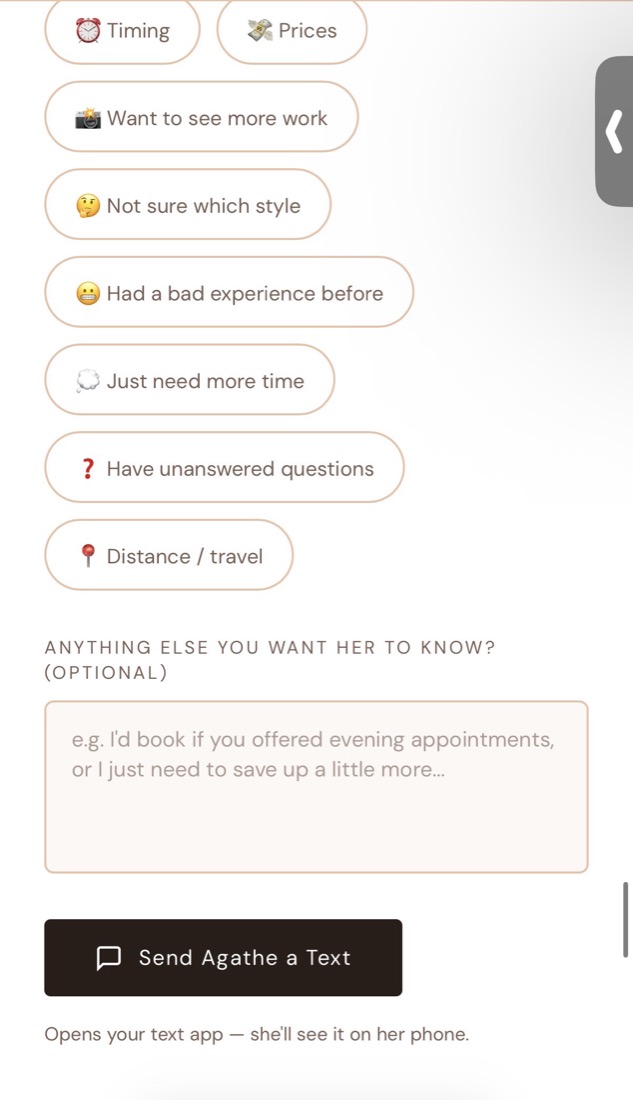
A live drop-off feedback tool that captures why visitors don't book.
How this one started
I met Agathe in a hair store. I was on a DIY journey, looking for someone to do my hair, and she asked if I needed a braider. Her son was with her. She showed me her page — and my brain did the thing it always does. It started issue-spotting.
Within a minute I'd found nearly every problem standing between her and more bookings. She had genuinely good work, but she was last in the DMV compared to other braiders doing the same thing. I told her I'd help her for free, and she could do my hair.
That instinct — landing on something and immediately seeing why it isn't working — is the same one this whole portfolio is built on.
Observation
The problem was never her skill. It was everything around the skill:
- Hard to book. No clear path from "interested" to "booked."
- No answers. Pricing, process, what's included, how long it takes — all a mystery. A visitor had to message her just to learn the basics.
- Didn't reflect her level. The presentation looked basic, so people assumed the work was too.
- No experience or vibe. Nothing that told you what it felt like to be in her chair.
And one structural problem: she was invisible in local search. Her name didn't match how people actually search ("Beltsville braider," "braider near me"), so even the closest client couldn't find her.
Hypothesis
If the experience answered every question before it was asked, made booking obvious, and showed people what her chair actually felt like, hesitation would drop and bookings would rise.
And a second, sharper hypothesis: the people who leave without booking are the most valuable data she has — and she was losing every one of them. If I could capture why they left, she could actually respond to it.
Decision
I rebuilt the experience to remove friction:
- Detailed service descriptions with timing, pricing, and what's included — no guessing, no DM required.
- A clear, obvious booking path.
- Content that showed the experience (the process, the welcome, the vibe), not just finished hair.
- Clear policies that set expectations without feeling harsh — warmth first, rules moved to the right place.
- A bilingual experience so Francophone clients felt welcomed from first touch to booking.
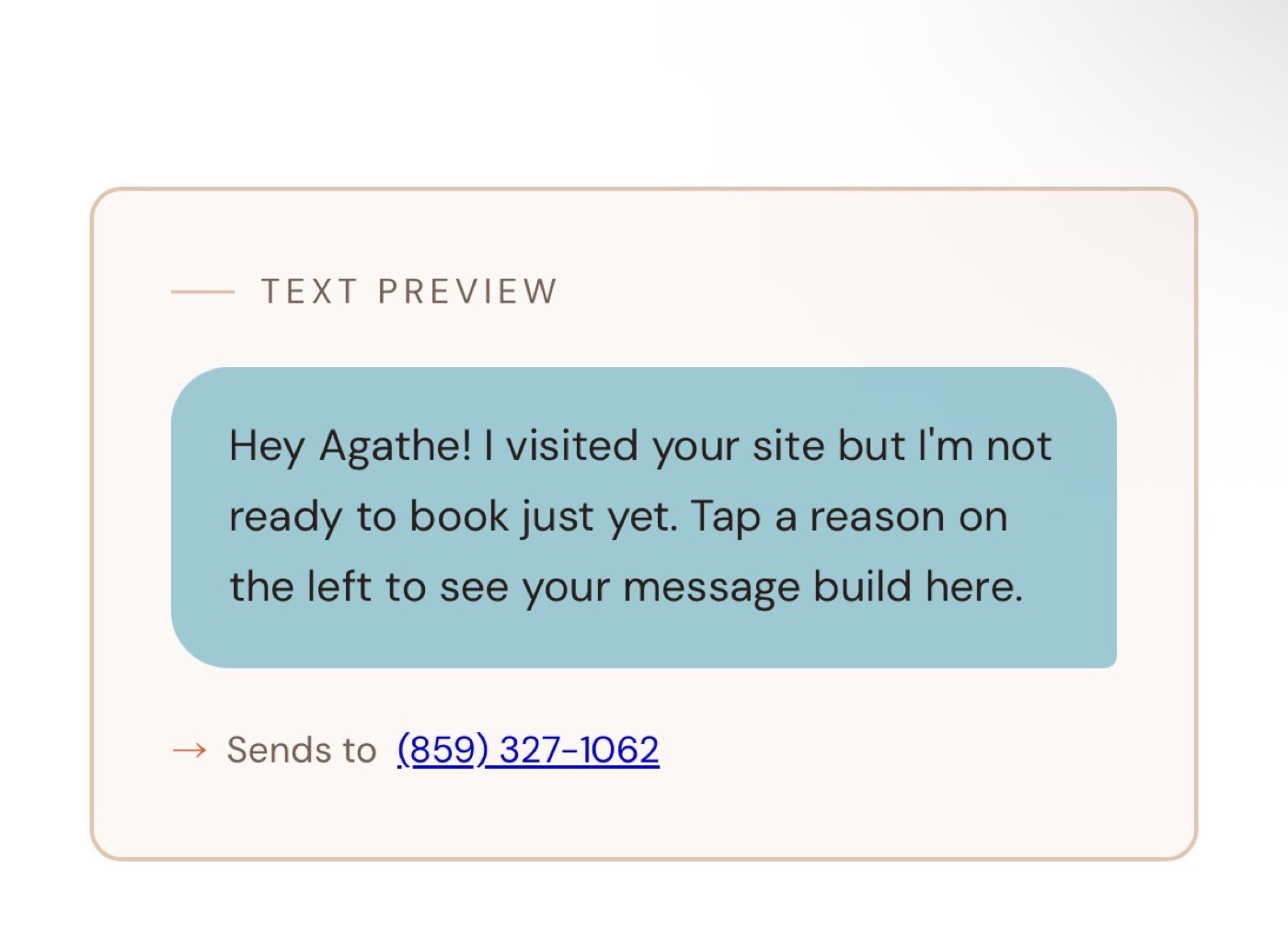
Then I built the part I'm proudest of — a research instrument. She couldn't afford an email newsletter platform. So I built her a custom feedback tool directly into her site: when a visitor doesn't book, the site asks them why. Their answer formulates a text that goes straight to her phone — and the response is tailored to the barrier.
The Artifact — the drop-off feedback loop
A closed research loop: capture the signal, categorize it, act on it. This is the centerpiece.
Visitor doesn't book
Instead of vanishing silently, they hit a gentle prompt.
"Not ready? Tell us why"
A short set of reasons: price, timing, unsure of style, first time, and more.
Reason captured → routed to her phone
The answer formulates a text message delivered to Agathe in real time.
Each reason → its matched offer
Price
Reduced deposit or payment plan
Timing
Waitlist with first-available notification
Unsure of style
Free consultation
Visitor returns & converts
The matched offer brings them back — and the loop starts over with the next visitor.
Closed loop: capture → categorize → act → convert → back to capture
A genuine closed loop. Behavioral segmentation in a live product: non-bookers categorized by barrier, each matched to a different intervention, each turn feeding the next.
The live instrument
Outcome
The real win is the instrument. She now has something almost no small business has: every "no" became information she could use, instead of a client who simply vanished. That's the difference between designing once and building a system that keeps teaching you. I gave her a brand — and a way to keep researching her own customers forever.
What this proves
- Conversion research — audited the funnel for the friction points where users drop off.
- Building research instruments — created a live tool to capture drop-off reasons when no budget existed.
- Behavioral segmentation — categorized non-bookers by barrier and matched each to an intervention.
- Inclusive UX — identified and served an unserved bilingual audience end to end.
- Information clarity — removed uncertainty as the primary conversion barrier.
Reflection
What I learned / what I'd do differently
What I learned: the richest data is in the people who leave, and almost no small business captures it. Building the instrument taught me that good research often means engineering a way to listen, not just analyzing what's handed to you.
What I'd do differently: I'd add lightweight tagging so the reasons aggregate over time into a simple dashboard — turning one-off texts into a trend she could actually read at a glance.